Monday, June 27, 2011

Art of the Car 2011

The annual Art of the Car Concours was held this weekend on the grounds of the Kansas City Art Institute. Celebrating the style and power of the automobile as a work of art, 180 cars graced the lawn on a hot, but cloudy Sunday. Rain threatened but thankfully held off allowing nearly 5,000 people to enjoy some wonderful, rare and beautiful machines.

We were greeted by the toothy grin of Dunbar the Buick's Great Great Uncle, a 1941 Super Convertible.


Greg relaxed and watched the crowd mingle. In center is a 1932 Cord 812 Beverly sedan.


A close up of the futuristic Cord, one of the most influential designs from the 30's. Front wheel drive too.


A massive and rare 1928 Cunningham V5. Picture does not do justice to the size of this classic. Cunningham was a hand built car from an old line carriage company in Rochester, NY. Ceasing production in 1931, they built hand made wooden hearse bodies for a few more years. V5 did not mean a V shaped 5 cylinder engine, but was a series name.


A jaunty 1920 Kissel Gold Bug Speedster. Amelia Earhart owned one.


A relic from the steam age. 1910 Stanley Model 62.


A one off show car by Nash from 1956. The Palm Beach was pure Nash underneath but sported a Pinninfarina body. If only... (sorry no back half of car, there was a crowd around it)


1953 saw the debut of 3 limited production super-luxo tourers from almighty GM as well as the similar Packard Caribbean. This one of them, a Buick Skylark. Greg noted the similarity in the side sculpture on today's Buicks, probably not a co-incidence.


The big, distinctive grille work of the Skylark


The luxurious hand made leather interior of the Skylark


A lucky survivor, 1974 Buick Le Sabre Luxus Convertible. Convertibles were on their way out by 1974, Buick built its last big convertible in 1975. One of 3,827 built, all original with 8,000 miles.


A big honking toothy 1948 Buick Super Convertible


A Chrysler Town and Country convertible from 1946. Lots of real wood work on this handsome machine.


A classy Mercedes 250 SEC from 1966


1947 Bentley, I always preferred the more rakish Bentley grille over the upright Rolls.


The air cooled Franklin 4 door sedan from 1926. Amelia Earhart had one of these too. She was a car nut.


Cadillac style from 1941 Fleetwood 60 Special


A rare visitor from Great Britain, a swoopy 1948 Diamler Green Goddess.


Stylish art deco steering wheel of a top of the line Studebaker President. 1938


Yep A Doozie! 1929 LeBaron bodied J


Even a Duesenburg engine is a work of art


Packards were out in force, a 1948 Packard Custom Eight.
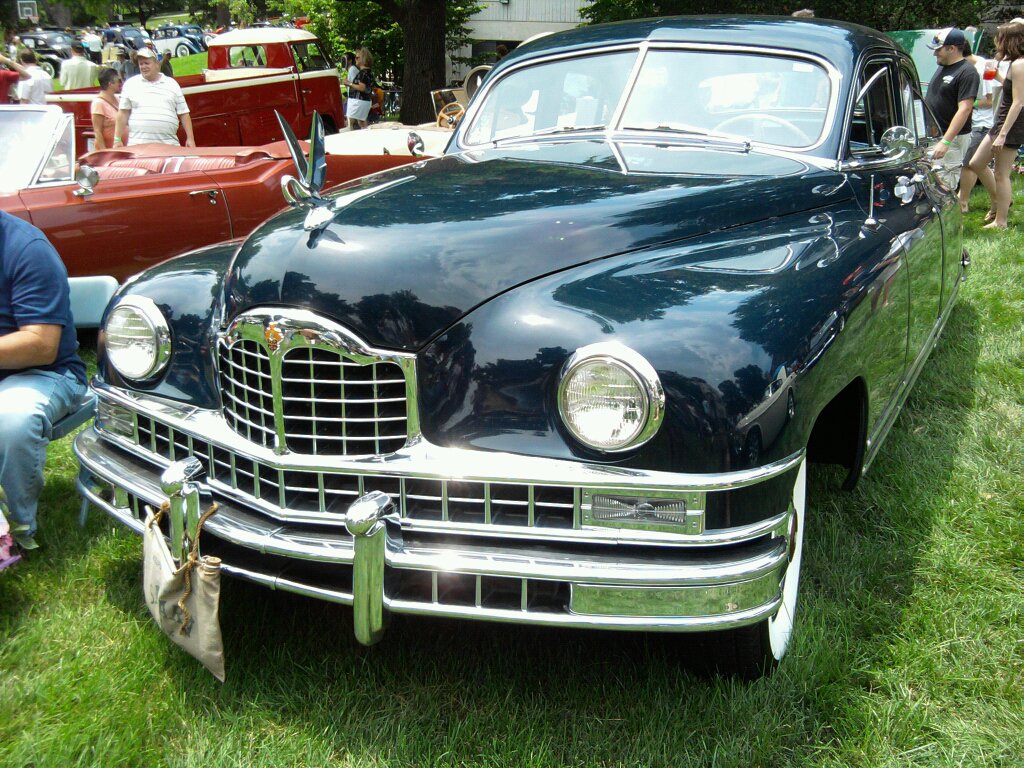


Ask The Man Who Owns One 1934 Packard 1105 Super Eight 7 passenger sedan


The 7 passenger sedan was a loooooong piece of work!


Another Packard Convertible a 1932 902 Eight Coupe Roadster.


Minty fresh Packard 903 Deluxe Eight Convertible.


The imposing visage of a 1932 Packard 903 Deluxe Eight Sport Phaeton.


The interior of the Deluxe Eight oozed luxury and hand crafted style.


A Ford Flathead V8, but where is it at??....


...in the rear of a very rare (9 built) 1936 Stout Scarab. Art Deco in looks but way ahead of its time inside; almost a minivan in concept with a center folding table and swiveling chairs. This one came from North Carolina.


NASCAR inspired Ford Torino Talladega, built for speed on the super speedways of the day.

Sunday, June 19, 2011

Season Finale Concert Bruch and Tchaikovsky

So yesterday I mused about the final performances of the Kansas City Symphony at the venerable Lyric Theatre. (Season Finale) As advertised, the orchestra treated the audience to a champagne celebration on the steps of the old girl, toasting her years of service. Before and after that, we were treated to a fine swan song of a concert befitting a grand theatre. Michael Stern, Music Director, led the orchestra in three crowd pleasing works, The Hebrides Overture by Mendelssohn, the Bruch Scottish Fantasy with violinist Stefan Jackiw as solo and concluded with the grand and dramatic Tchaikovsky 4th Symphony.

By now you know that the triumvirate of Mendelssohn, Schumann and Brahms are not on the top of my list of composers that I would take with me on the proverbial desert island. Mendelssohn's Overture (also known as "Fingal's Cave") received a fine but somewhat subdued performance from the orchestra. The winds as usual were in fine form, contributing to an agitated opening section, depicting the wild Hebredean seas. Stern kept the overture at a fair pace, but I did not feel the epic flow and grandeur that Mendelssohn saw in the rugged cave. Maybe the somewhat fussy and square Mendelssohn just couldn't put it into music. The strings were in good form as were the brass and spotless horns.

Stefan Jackiw (the unpronounceable looking name is Jack-eev I am told) has all the potential to be one of the finest violinists of his generation. At 26, he has made quite a name for himself with very mature, sensitive yet powerful performances. I have heard him in a wonderful Tchaikovsky Violin Concerto performance with the Russian National Orchestra and in a solo recital. Jackiw and Stern offered the popular Bruch piece (at almost 30 minutes truly a violin concerto and more than just a trifle "fantasy") in a somewhat relaxed performance. Jackiw's tone was always spot on and clear, even in the highest registers, which Bruch used to great effect in this truly Scottish tinged work. His double stop melodic lines could have easily come from a Scotsman's viol or pipes as he sang his long and winding tunes. If the slower movements were a bit leisurely, the certainly allowed Stern, the orchestra and soloist to milk every turn and intimate detail of this complex and full score.

Jackiw was magnificent in the second movement's earthy, bagpipe drone influenced, main melody with special shout out to principal flute Michael Gordon for his incredible duet with Jackiw in this movement, matching the soaring skittering violin in every note. The Andante sostenuto 3rd movement was sweetly singing but again a bit reticent. The popular dancing finale seemed to light a fire under all concerned, with Jackiw's constant double stops pristine and clear, with just the right amount of grit. Certainly the capacity audience appreciated the sensitive and detailed performance.

Used to be I would cringe whenever I knew the KCS horns were all exposed and important. The incredibly powerful opening horn figure of the Tchaikovsky 4th is one such place, but demonstrating the transformation from small town orchestra to regional powerhouse, the horns were solid, bright, commanding, powerful but not overbearing. I knew we were in for something special. Seemingly igniting as if this were the last time they would ever play period, the orchestra nailed every passage, followed Stern's brisk but never rushed tempo, relishing every surging, drama filled passage of this hyper-romantic work. Yet, as in the wistful waltz like center section of the first movement, the orchestra could hold back and produce some contrasting delicate sounds as well.

Fine wind work as usual, commanding yet well integrated brass, judiciously used but spectacular percussion (the wonderful 3 cymbal pair crash) and crisp and together strings abounded. In particular the pizzicato strings were magnificent in the swift and vibrant Scherzo. The festive and busy finale brought the work, the 2010-2011 season and the career of the Lyric to a grand conclusion.

Saturday, June 18, 2011

Season Finale

Saturday AM I, as I have many times, opened my drop leaf desk, reached into the far right cubby hole and got the tickets for the weekend's Kansas City Symphony concert. Emblazoned on this set was "Season Finale: Tchaikovsky's 4th", obviously signaling the end of the road for this season. But more than that, this concert is the last in the venerable, lovely, frustrating, historic, acoustically nightmarish Lyric Theatre. Many are rejoicing, awaiting the new Moshe Safdie/Yasuhisa Toyota built Kauffman Arts Center. Some old timers want to cling to the past.

Befitting a befuddled Pisces, I have mixed emotions. The Lyric is a monument to 1920's Roman influenced architecture, and was modeled after the Temple of Vesta in Rome. Built as a Shrine Temple, it has been a movie theatre, live theatre, TV studio, opera house, ballet theatre and concert hall, frequently all at once. One can only imagine the great artists who have performed on its cramped stage. As I mentioned in a past post about the last performances of the Lyric Opera, (Retirement) many patrons seem to relish the intimacy and small venue atmosphere of the Lyric while others just thought it crowded. The wonderful detail in the ceiling of the hall, the huge columns, marble and big heavy doors lent an air of solid craftsmanship.

One just had to experience a performance in the old girl to realize her major shortcomings. The stage is small and cramped, limiting what opera can do. When the chorus joined the orchestra on stage, everyone was squished together virtually sitting on top of each other. With only one theatre shared by the symphony, opera and ballet, the various groups had to often rehearse in different locations and then spend crunch time getting used to the theatre.

For us patrons, the orchestra level had more spacious seats but offered muddy, dull and often simply dead acoustics, especially if you were trapped under the balcony. From many seats you could not see past the first couple rows of the orchestra; the winds, brass and percussion could be cardboard cutouts with speakers blaring recordings for all we know. The balcony had better sound and better views, but the seats were cramped with no legroom. I think European low cost airline Ryanair was inspired by the Lyric.

Tonight I and my friend Gerry (who replaced Barbara after she moved away) will occupy Right Center Balcony Row G seats 7 and 8 for the last time. Gerry is one that is thrilled about the move as he hated the cramped seats. He liked the orchestra section, but I was a butt and refused to move. Next season is Grand Tier row AAA # 117 and 118. The ticket office fellow gleefully told me that even though the seats for the next better section were gone, these were actually closer to the stage than my old seats, and had lots of leg room. That should make Gerry happy.

I saw lots of fine productions and concerts at the old Lyric, but I guess it is time now to move on. The new center is the talk of the concert world; according to those who have tested the waters, it is superb. The orchestra's Helzberg Hall will have a fabulous 4 manual, 102 rank Casavant organ installed early next year, the opera theatre has seat back screens for translations and scene descriptions. Great things are coming.

They are having a champagne toast to say good bye to the old girl tonight (I hope they learned from the last time and do NOT pop the corks before the first half ends) and I will join all to cheer the Grande Dame's glorious past and reflect on her murky future.

Sunday, June 05, 2011

Kansas City Symphony: Mena Conducts Grieg, Beethoven and Schumann

A sultry Saturday evening in KC extended its grip inside the venerable Lyric Theatre last night, the vintage AC units straining to cool the vast space. Perhaps the old building was groaning out a last protest towards its imminent demise as a performance space. Nevertheless, the show goes on and frequent guest Juanjo Mena was on hand to lead the Kansas City Symphony in a program of Grieg, Beethoven and Schumann. German pianist Markus Groh was the soloist in the Beethoven 3rd Piano Concerto.

Opening this program of music firmly rooted in the 19th century was the Lyric Suite op 54 by Grieg. One of Grieg's greatest accomplishments is that of his set of 66 Lyric Pieces for piano composed in 10 books from 1867 to 1901. Many of them such as Wedding Day At Troldhaugen, To Spring, March of the Trolls, and Butterfly are known to just about anyone who studied piano. Many of the little pieces have been arranged for orchestra but the set from op 54 (Shepherd Boy, Norwegian March, Nocturne and March of the Trolls) is most often performed and recorded.

A hint of shaky string intonation at the very beginning of the lyrical and passionate "Shepherd Boy" did not bode well, and indeed one could have asked for a bit more flexibility in phrasing and some harp to penetrate the string only texture. The "Norwegian March' came together well with some excellent as usual woodwind work (the recurring little clarinet figures for example), the brass were foreboding but never overwhelming. "Nocturne" could have used a bit more flow and grace but was redeemed again by fine winds. The final "March of the Trolls" must be great fun to play and the orchestra came to life with a perfect blend of macabre and bouncy enthusiasm.

In his 3rd Piano Concerto from 1800, Beethoven said Auf Wiedersehen to the more elegantly formal concerti of Haydn and Mozart and set about writing a most symphonic concerto. The opening orchestral tutti is a fully argued symphonic statement in and of itself, not merely a flourish filled opener. The piano is more fully integrated into the orchestral texture and is key to introducing new themes and setting a movement's tempo. This emphasis on symphonic argument and development renders this Beethoven's least "flashy" and, ultimately for me, most satisfying concerto. Groh and Mena and the orchestra seemed to agree with this assessment, milking all the subtle yet frequently palpable drama from the work. Groh's first movement cadenza was a perfect example of this, well integrated into the whole fabric, alternatively sweetly lyrical and boldly flashing.

The Largo, in all intents and purposes a nocturne worthy of Chopin, second movement begins with a simple prayer and ends with an elaborate song of praise. Groh's tone and rhythm was fluid and graceful, never slack, allowing the piano to sing its long, winding phrases. The orchestra mostly accompanies and comments in this movement and the forces well knew their role.

Groh launched into the fleet and spicy rondo with abandon, the orchestra following close behind, but getting overwhelmed in the brisk final measures. Groh tossed off the runs with grace and style, but unlike the unbeatable master Leon Fleisher, he didn't give the complex runs the subtle variations in tempo and emphasis that marks a superb performance.

Thankfully, someone got to the audience and there was no applause between movements as has been the custom as of late. Maybe they were too hot.

I rate Robert Schumann along with Brahms as one of those colorless, foursquare mid 19th century composers whose music just does not speak to me. I know many, many disagree with me, but it is what it is with me, dear readers. Thus a performance of Schumann's Symphony # 4 (not really his last, but as with many composers of his era, the numbering is AFU) was not my idea of a grand time on a hot summer night in a hot old theatre. Thankfully, Mena and the orchestra felt otherwise and delved into the score with relish. The first movement was perfectly dramatic, the brass forceful but never making the texture even more dense. The short Romanze was fine and Mena used just the right amount of tempo and dynamic change to relate the movement back to the introduction of the first movement, making them one grand gesture. Of course the whole symphony is played without much or any pause, making the whole thing one mega-sinfonia. A breezy and well articulated scherzo followed with some fine rhythmic string work from the strings. If the strings go slack, the whole shebang becomes even more turgid, and that certainly was not the case last night. Mena seemed to really relish the Viennese waltz segments of the scherzo's trio. The strings and brass were majestic in the grand transition from the scherzo to the finale, bringing the work to a fine conclusion.

Ok, maybe a better piece than I give it credit for (Schumann, especially his fabulous 2nd Symphony is a rung above Brahms in my book anyway) especially when an orchestra and conductor give a fine performance to an audience that by the end of the stifling evening seemed to want to just get on with it.

As for those who are bristling with my Schumann bashing, note that I actually have and sometimes actually listen to 4 Schumann Symphony sets in my collection, Szell/Cleveland, Bernstein/NYP, Dohnanyi/Cleveland and Chailly/Leipzig with Mahler's "Retuschen" that I actually find interesting, further infuriating the Schumann fans in the crowd.

Only one more concert series to go in the old Lyric Theatre in a couple weeks. Hopefully Helzberg Hall will have better HVAC than the old Lyric, or maybe as I said, the old girl is just shooing us out.

Sunday, May 22, 2011

Kansas City Symphony: Brahms, Beethoven and Prokofiev

Ask any of my classical music loving friends and they will tell you Brahms is not high on my list of favorites. There is a notable exception to this and that is the first piece on this weekend's Kansas City Symphony concert, Music Director Michael Stern on the podium: the lovely and compact "Alto Rhapsody", opus 53 performed by Mezzo-Soprano Sasha Cooke as solo and the Kansas City Symphony Chorus. Beethoven's sunny Symphony # 1 and Prokofiev's dramatic cantata "Alexander Nevsky" completed the program.

Written as a wedding present for Robert and Clara Schumann's daughter Julie, this gentle and yet frequently passionate jewel is not frequently heard in concert, probably due to the requirement of a solo alto/contralto and a sizable male chorus. Pity, for it is one of Brahms' most heartfelt and ingenious works. One of my aforementioned problems with Brahms is my perception that his orchestration and sound is colorless and conventional. Although the Rhapsody uses a standard classical orchestra, the deft writing for the alto voice coupled with the subtle power of the male chorus combines to create a stunningly beautiful and powerful message. The chorus is used sparingly, but to say it is in the background negates its important contribution.

Unlike some singers with such a cognac colored voice, Cooke's is clarion clear and free of wobble. The first two verses (from Goethe's "Harzreise im Winter") were appropriately anguished and touched with poignancy. When the clouds lift and the mood and key changes ("If there is on your psalter Father of love, one note his ear can hear then refresh his heart!"), Cooke's voice lightened and soared, the mood fully warmed by the clear and superbly balanced chorus. A most lovely and sincere performance by an artist at the height of her voice, accompanied by a fully seasoned and capable chorus and orchestra.

Beethoven was still under the spell of Papa Haydn when he wrote his Symphony # 1 in the last years of the 18th century, yet one can hear themes, rhythms and motives that will come to full fruition in the Eroica and beyond. Stern and the orchestra were truly in full command of this charming work, bringing out the drama and tension where appropriate and yet milking all its grace and wit as well. Especially noteworthy was the fleet and limber "Menuetto, Allegro molto e vivace" 3rd movement, a full symphonic scherzo in all but name, with precise strings and gaily chattering winds. The finale was taken at a brisk but not inappropriate tempo. The opening slow introduction was colored with the right amount of drama, the skittering strings taking the work to a grand conclusion.

Editorial: But please, KCS audience, WHO (???) is behind all the clapping after each movement? You didn't used to do that, but suddenly it seems all the rage. You all aren't rubes, you know better!

Prokofiev, like his countryman Shostakovich did to a much greater extent, turned to film music to make a living. Prokofiev, however, took his some of his film work and reworked it into concert forms. The score to "Alexander Nevsky", a 1938 Sergei Eisenstein film of the same name, was thus soon reworked by the composer into a dramatic cantata for chorus, mezzo solo and orchestra.

The work in 7 sections culled from the longer film score demands a large orchestra and chorus. Happily, Stern and all the forces delivered a dramatic and convincing performance. The usual God-awful Lyric acoustics muddled the chorus when the orchestra was in full throttle, but for the most part the chorus and orchestra were well balanced. The chorus seemed to be well drilled in this rhythmically challenging music and thus were precise in their diction and clean in their entrances. They certainly could menacingly shout and snarl when called upon, which was quite often.

The opening "Russia under the Mongols" dripped with melancholy over the occupation of Mother Russia, while the chorus foreshadowed the coming battles with their menacing tone. The "Crusaders in Pskov" section mockingly used Latin to evoke the brutal invaders, the chorus and large orchestra oozing with barely contained outrage; leading directly to the boldly confident "Arise ye Russian People", filled with folk song and dance.

Many consider "The Battle on the Ice" section the epitome of battle music and one of the most effective uses of music in film. Stern and the vast forces dug into the music with a furious and cinematic performance. Here the big sound of the full orchestra sometimes shoved the chorus into the background, but the whole sound was perfectly overwhelming.

While "Battle on the Ice" may be the more famous, the following "The Field of the Dead" is in my opinion Prokofiev's supreme achievement. A dark lament of a girl seeking her lost lover, Sasha Cooke's dramatic, tender yet almost shell shocked performance was well neigh perfect. Again, as in the Brahms, Cooke was dark and creamy but never becoming clotted cream. Her lament was sincere and frankly, for me, the highlight of the work. The orchestra and chorus brought the work to a cacophonous, huzzah! conclusion with Alexander's triumphal "Entry into Pskov", bells, brass, percussion (it was fun to watch the percussionist mount the ladder to strike the huge tuned metal plate) and chorus to the fore.

As an aside, it is somewhat unnerving to realize that I have only two more concerts in my now comfortable (well as comfortable as one can be in the cramped balcony, maybe "familiar" is a better term) Right Center Balcony Row G seat 7 perch. The new Kauffman Center is about done, the orchestra was treated to its first rehearsal there (thus making the Beethoven 1st the first music for orchestra heard in the new hall) and from all the buzz is quite spectacular. Sad in a way to see the lovely and historic (oh what great musicians have performed there) become redundant, but KC has a glut of theatre and concert hall venues so I do not see a rosy future for the old girl.

Nevertheless, performances like these make the legacy of the Lyric all the more wonderful and important.

Wednesday, May 18, 2011

Mahler 10

Gustav Mahler died on this date 100 years ago. At that moment one of the greatest musical voices was stilled at the all too young age of 50. Racked with disease (which simple antibiotics could have cured, but alas had not been discovered as of yet) saddened with grief over a daughter who had recently died and the revelation of his unfaithful wife Alma and her affairs, many who saw him thought he looked 25 years older.

Mahler spent much of his last 3 years in New York at both the Metropolitan Opera, overseeing some widely acclaimed productions and then at the New York Philharmonic where some say his influence reigns today. Sadly, since this was before recording an orchestra became practical, we have no record of a Mahler led performance. We are poorer for that.

Despite his busy opera and concert schedule, Mahler found time to compose in the summer when he returned to Vienna and his summer cottage in the mountains. There he set to paper, in these last days, 3 masterpieces, the 9th Symphony, "Das Lied von der Erde" and the mysterious, controversial and often misunderstood unfinished Symphony # 10.

If the 9th and "Das Lied" are stories unto their own, the 10th is worthy of a novel.

Mahler worked feverishly on the 10th during the summer of 1910 in Austria. He had completed the 9th and Das Lied but had yet to have them performed. Dear Gustav thought he had cheated the curse of the ninth (a superstition that all great composers will die after completing their 9th symphony, as did Beethoven) by interjecting "Das Lied" in between the 8th and 9th, making the unnumbered "Das Lied" a de facto 9th. Thus a grand 10th was planned and soon was making great progress before he left Austria in September to fulfill his obligations in New York. Becoming progressively sicker, he returned to Europe in April and died in Vienna in May. The 10th, partially done but awaiting the summer Mahler never saw, lay incomplete.

If his wife Alma and friend Bruno Walter had their way, we would have heard none of the work at all. The opening Adagio was complete and fully orchestrated and scored. The other 4 movements were in various stages of completion, but the music, the notes as it were, were all there. What was missing was orchestration, dynamics, phrasing and the inevitable revisions. Because of that only the Adagio was ever published but rarely played. Alma forbid any completions.. Walter wanted it all destroyed. I have never forgiven him for that.

Since there is much material to work on, several completions have been made of this remarkable work. Clinton Carpenter completed a version as early as 1949 but only published a final version in 1966, Hans Wollschläger worked on a version in the 50's but gave up. English musicologist Joe Wheeler did several versions in the 50's and 60's as well. Another English musicologist Deryck Cooke published his version in 1964 after rousing much interest in the work in a pioneering radio broadcast in 1960. Cooke's version was the first to be performed in 1964 in London with the LSO under the direction of Berthold Goldschmidt, who, truth be known, contributed more than he has been credited. These historic performances, plus Cooke's 1960 illustrated lecture can be heard in a Testament release. Since then others have made their own versions, and all have their supporters, but that of Cooke (and subsequent revisions) has become the standard.

My tired eyes and hands can not permit me to go on all much longer, so I will spare you a note by note description of this fabulous work, it is one that has to be heard. Any completion of an unfinished work is an amalgam of compromise and educated guess work, and the Mahler 10th is no exception. But since the adagio was complete and so much of the music is there, what we have is a flawed, certainly not as Mahler intended, symphony that is so powerful it is hardly describable in words. Mahler was moving into a new sound world with the 10th (the 9th too for that matter); gone were the Wunderhorn Songs, the cowbells and folk instruments, replaced by lean, spare textures, darker sounds and the beginnings of dissonant expressionism. Mahler's anguish fills every page. The last movement begins with a muffled funeral drum (controversy rages to this day as to the number of beats, volume and texture of that drum), ends with a scream of pain and release to an angelic close. In between is one of the most achingly beautiful melodies ever written.

Something in this piece speaks to me like nothing else. I first heard it in the 70's on a Decatur Public Library LP of the first commercial recording by Ormandy/Philadelphia. Since then I have amassed every recording ever made, either LP, CD or download (we don't always talk about those). If you want a list of the recordings, go to the Wikipedia article on Mahler 10 there is a fine list there, compiled by yours truly. I never tire listening to it and it is playing now (Sanderling Berlin SO, one of my favorites) as I write.

Soon I will finish this little essay, grab a glass of wine and listen again to this creation. I will raise a toast to Gustav, immerse my being in the sound, occasionally close my eyes, and, as one would do upon seeing the ruins of antiquity, imagine what Mahler would have done if he had not passed to the great beyond 100 years ago today.

Saturday, April 30, 2011

Kansas City Symphony: US Premiere Dorman "Frozen in Time"

Appropriate fare for a concert close to Earth Day, the Kansas City Symphony, under the direction of Music Director Michael Stern, performed 3 works dramatizing the creation of our terrestrial orb. Franz Joseph Haydn's "The Representation of Chaos" from his oratorio "The Creation" opened the program. Darius Milhaud's jazz drenched "La Création du Monde" (The Creation of the World) followed. The first half ended in spectacular fashion with the US premiere of Avner Dorman's "Frozen in Time" Concerto for Percussion and Orchestra, which the composer describes as "an imaginary snapshot of the Earth's geological developments from prehistoric times to the present day. Austrian percussionist Martin Grubinger was soloist. Earthy and elemental in its own right, Dvorák's lively Symphony # 8 comprised the concluding half.

Haydn's "Representation of Chaos" was a most innovative piece for its time. In an era where musical compositions were held to strict form and harmonic relationships, Haydn's diffuse overture seems to have themes, phrases and harmonies shifting to and fro as if in a primordial soup. Structurally, however,it is a fairly tight sonata form. Haydn invokes his "chaos" by avoiding cadences as much as possible and allowing ends of phrases to fade into the texture, foreshadowing Tristan and Isolde many years later. Stern led the reduced orchestra in a leisurely, appropriately meandering performance. Some iffy string intonation at the beginning marred the performance somewhat as the small orchestra left many parts exposed.

French composer Darius Milhaud, like many European composers in the 20's (Stravinsky comes to mind of course), became influenced by jazz. While many copied the almost orchestral bands such as Paul Whiteman, Milhaud's influence was in the small clubs of Harlem, where few white people ventured. When called upon to write a ballet in 1923, Milhaud used this inspiration for "La Création Du Monde", a setting of African creation stories. The small 18 member ensemble (two flutes, oboe, two clarinets, alto saxophone, bassoon, horn, two trumpets, trombone, timpani, percussion, piano, 2 violins, cello and bass) dug into the jazzy score with often appropriately raucous relish, yet frequently relaxed to allow us to savor the colorful details and lovely melodic lines.

Paraphrasing the slogan for Jiffy Pop popcorn from the 1960's, Avner Dorman's "Frozen In Time" Concerto for Percussion and orchestra is as much fun to watch as it is to hear.

An amalgam of earth music ranging from ancient African to jazz and rock, "Frozen In Time" has an elaborately staged but never pretentious program. The first movement "Indoafrica" is based on Indian classical rhythmic cycles and scales. The huge battery of drums transports the music to rhythmic Africa while the marimba and mallets represent the more melodic Indian tradition. "Eurasia", a slower central movement, is laced with elements of European and Central Asian traditions. The ghost of Mozart appears as does the Italian Siciliana and some frosty Nordic chords and sounds. The orchestra strings predominate, underpinning the metallic percussion. Haunting and delicate in contrast to the more frenetic outer movements, "Eurasia" would be satisfying as a stand alone piece. "The Americas", with everything from Cuban dance to Broadway swing, brings the whole work to a most rousing conclusion. Snippets of the "Indoafrican" and "Eurasian" music weave in to remind us we are but one Earth.

The huge orchestra has plenty to do and is surely an integral part of the work, but the show is all the solo's. Martin Grubinger, who premiered the piece and has played all over the world now, is simply indescribable. Lean as an athlete and full of enthusiastic energy, he is fully in command of the work and the percussion. I do hope he records the piece sometime, but only if video is provided. His encore, (my lousy hearing did not let me catch what he was playing, but it seemed to be an Austrian hymn or lullaby of some sort), was the epitome of subtlety. Played on the marimba, often on the threshold of audibility, it left the audience breathless. Both Grubinger and the work received a rapturous ovation that most composers and performers only dream about. Sadly, the composer was not able to be at the performance but he can be assured that Kansas City certainly has many Avner Dorman fans after last night.

Sometimes, after such an overwhelming experience, the final work on the program can seem like an after thought or a fluffy dessert at best. In this case Stern and the orchestra gave a rousing and exquisitely detailed performance of Dvorák's masterpiece. From the delicate opening bars of the introduction through the dancing conclusion of the finale's coda (the various tempo shifts cleanly shaped and accented without jarring, Stern and the orchestra superbly negotiated the score's sweep and flow. Wonderful solos from the always fine KCS winds contributed to this fine and well received performance.

Wednesday, April 13, 2011

Retirement

After a combined total of around 10 years, I am retiring tonight. It was sort of forced on me; progress often makes people and things redundant. I love that word "redundant", more graceful than "useless" or "unwanted", but still ringing with finality. I don't think my "employer" even really noticed until I mentioned it yesterday when I agreed to work on Wed rather than Friday.

At least 4 times a year since around 1998 (minus my 4 years in St Louis and elsewhere) I volunteered at the Lyric Opera of Kansas City's "Ingram Room", an opulent, private lounge for the most generous of patrons. They could sip a glass of wine from fine gold rimmed, crystal glasses, indulge on hors d'oeuvres or sweets on elegant green and gold plates and chat amiably in the frankly small, over stuffed room.

For the most part, the high and mighty of KC society were a pleasant lot. The truly rich were usually the nicest, the younger working rich (bankers, lawyers, etc) were often the most pretentious and nasty. One lady, whose hubby is with a firm that sponsors some of the productions, is a nasty, royal, trashy pain in the ass. Hope to never see her again. I no longer do business with their business either and that makes me feel better.

It was fun watching the upper crust flit, flirt, munch and sip. Sort of like watching a display in a zoo; species Richius Americanius genus Kansasian Citianius. "Hello!!! how are you, so good to see you!" Yeah, right, I know they hate each other actually. More fun was herding them out at the start or at intermission so we could get on with the real work, enjoying the treats the caterer brought.

For my first few years, Donna was the coordinator. We called her "Angel Bitch". She was the nicest, kindest lady you could know, but her Ingram Room was done her way. Wine bottles were always in a bottle coaster, "labels forward" her demand. We were quiet during the opera, everything in its place. I missed the AB days, they were the best.

One performance found me in my usual place behind the bar when I noticed a couple of ants crawling on the counter. I reported it to AB but she did not want to believe me until she saw the little creatures scurrying around. DISASTER! I soon saw they were coming from a live orchid on the counter. So it was removed and the ants dispatched post haste. Unfortunately, the person who designed the room (in the style of Marie Antoinette's boudoir) was there and was not amused at the removal of the orchid. It was not until Donna showed him the plant crawling with the little critters that he believed it, but still blamed us for ruining the evening. I knew not who this person was, but now I do... nothing has changed.

One of the many people who passed through the Ingram Room was describing one of the hors d'oeuvre selections to a be-furred and glittering patron: "Crudités with a spicy penis..spicy penis....uh uh oh dear a pee sauce...." she stuttered totally embarrassed and tongue twisted. The gracious patron just said "dear, let's just refer to it as 'the sauce'." She was trying to say spicy peanut sauce, but it just was not to be. We laughed until it hurt.

You get to know people's habits when you serve them regularly and they, no matter their station in life, appreciate it. I endeared myself to many by remembering their drink of choice (we usually just had wine, soft drinks and coffee so it was not a big deal) and having it at the ready for their asking. Joan loved a bit of white wine with a splash of sprite on ice for a frosty spritzer at intermission. Evan, the Opera General Manager,usually asked for a Sprite at intermission. When I would hand him one with out asking, he was usually amazed. "I guess they know me here" he mentioned to a fellow patron when presented with the fait accompli. Another patron always wants red wine, so I have one ready for him. Mrs. Ingram always wants decaf coffee at intermission, half a cup please. Jim will always be the first to taste the evening's fare and pronounce his verdict.

Sometimes, I would sneak in and see the opera but often it was more fun just hanging around at intermission, eating the goodies and gossiping. I learned a lot that way, got to hear all the drama of mounting a professional opera and even got to meet some of the cast and composer Jake Heggie to boot. I so wanted to ask him about his life with Johanna Harris, but I thought not to pry.

This week marks the last opera in the old faithful Lyric Theatre. The new Kauffman Theatre at the Kauffman Center (God do those folks have $$$) will replace the venerable structure. There will be a patron lounge, but it will not be "ours". The Center will staff it and cater. The lovely items of the Ingram room were recently sold to benefit the Opera Circle. I got a gold washed brass basket in which we placed napkins or silverware for the desserts. I had washed, served out of, put away or handled in some fashion just about every item in the place so it was fitting that I take one home.

I am sure the Opera's new home will be a whole new experience, with better seats, acoustics and even monitors in the seat backs for the translations. But as much as the Lyric has become redundant, I will miss the more intimate feeling of a small family, sometimes a crazy, bickering one, producing art for the community to enjoy. In gaining a big, modern, state-of-the-art theatre, we lose a bit of a connection.

Me? I lose a job and the intangible benefits that went with it. Think they will present me with a gold watch?

Sunday, April 10, 2011

St Louis Symphony Mahler 2

It seems I am falling into a pattern. Every year or so I gas up the old Buick and head east on I70 to the other side of the state to my old haunt St Louis, MO to partake of a special concert by the usually excellent St Louis Symphony. A couple seasons ago it was a wonderful Britten War Requiem with Music Director David Robertson and my favorite Diva (and Facebook friend) Christine Brewer. Next was an increasingly rare appearance by the great Maestro Stanislaw Skrowaczweski and his specialty the Bruckner 8th. So, in keeping with tradition, I headed to St Louis for a special concert of Mahler's grand Symphony # 2 with the St Louis SO, Christine Brewer, soprano, Kelley O'Connor, Mezzo and the St Louis Symphony Chorus all under the direction of Music Director David Robertson. Samuel Barber's "Prayers of Kierkegaard" opened the show.

Barber's "Prayers of Kierkegaard" for Chorus, Soprano and Orchestra (based on the writings of Soren Kierkegaard) received a grand and emotional performance. The opening prayer, beautifully pure and sung with perfectly Gregorian piety by the men of the chorus, was followed by the reverent and passionate "Lord Jesus Christ who suffered all life long featuring Brewer's commanding but clear and sincere soprano voice. The final two prayers increased in drama and thickened in choral and fanfare laced orchestral texture concluding with the final prayer, a richly thick chorale "Father in Heaven, hold not our sins up against us".

But the evening was really all about the Mahler and overall it was a satisfying and frequently eloquent performance. Frankly the two vocal movements came off best of all, aided by the masterful soloists and the magnificent chorus. Robertson and the orchestra certainly did no harm to Mahler and his incredible score; in fact the performance was full of finely tuned details, moderate and appropriate tempi and fine orchestral work. But to my ears, the first two movements lacked the passion, swagger and flow that would have made this a perfect live Mahler 2.

Take the fabulous second movement "Andante Moderato" for example; finely played, lush strings, a perfectly delicate performance of the pizzicato string/flute/piccolo episode, fine pace... but no flow. The best performances will have the landler rhythm almost like that of boats rowing, a strong accent and push, a glide and then another accent as the oars hit the water for the next stroke. Robertson was just too foursquare. The damn street noise of sirens careening down Grand Ave didn't help, but what can one do?

The first movement began with a thrilling flourish; the basses digging into the opening motives with vigor and a tinge of foreboding. As the movement progressed, one sensed one was listening to a fine performance, but with the same bit of slackness as I described for the Andante. Again, far far far from a poor performance, maybe I just have Bernstein's white hot performances burned into my Mahler senses.

The incredible scherzo, "In ruhig fließender Bewegung" (with quiet, flowing movement) is one of my favorite Mahler movements. Robertson and the orchestra began to stir in this movement, with more elasticity and drama and a better sense of Mahler's flowing, folk derived rhythms. Sadly, the movement was marred by a too harsh and sharp rute that sounded more like solid sticks than the brush-like reeds which contribute more of a texture than a sound.

Kelley O'Connor's "Urlicht" was beyond description, and almost seemed to bring the work to life. I have never, ever been so moved by the opening "O Röschen rot" that just seemed to ignite out of the dark rudeness of the Scherzo. O'Connor's mezzo was dark, but clear; I hope she records the part with a major orchestra someday. A purely magic movement. Ok, I thought about not mentioning the off-the-mark brass in the chorale just after O Röschen rot, but jarring it was and blemished this otherwise incredible movement.

Yet as if inspired by this delicate moment, the orchestra came to life in a thrilling, powerful and dynamic finale. The augmented brass never was harsh or overwhelming, the percussion perfectly integrated into the texture and the woodwinds and strings always bright and precise.

The chorus' hushed entrance "Aufersteh'n, ja aufersteh'n" was just heavenly. This well trained and professional group could whisper and yet a moment later bring the old beams of Powell Hall down around us. Brewer (her soprano slowly rising from the hushed chorus was mesmerizing) and O'Connor soared majestically above it all as required, just as comfortable being part of the vocal texture as they were as soloists. Blemishing this otherwise fine movement were the offstage brass which were off tempo and off tune, not well coordinated at all.

The concert was done in memory of longtime chorus member and chorus manager Richard Ashburner, who died all too suddenly and young this past March. There was hardly a dry eye in the chorus or among the soloists and several in the audience as well during the long and well deserved applause.

I know I sound a bit picky, but as my friend and fellow concert goer Steven said, we have a right to be critcal, since as devoted fans of Mahler, we know the music probably as well as any chorus or orchestra member. It was a fine and sometimes glorious Mahler 2, worth the cross state trip for the fine choral and solo performances in the last two movements.

Sunday, March 27, 2011

Kansas City Symphony: Elgar and Ravel

Larry Rachleff, Music Director of the Rhode Island Philharmonic and Director of Orchestras at Rice University in Houston, made one of his regular appearances with the Kansas City Symphony this past weekend. Rachleff, quite in demand as a guest conductor and teacher, always brings a fresh and interesting program and a certain sense of energy. This concert consisted of 4 fairly standard and familiar works, the Overture to Benvenuto Cellini by Berlioz, the colorful Piano Concerto in G by Ravel, Barber's Adagio for Strings and concluding with the popular "Enigma" Variations by Elgar. Argentinian Ingrid Fliter was the soloist in the Ravel.

Berlioz's Massive opera about the free spirited Italian sculptor is rarely performed or recorded, but the overture remains one of his more popular pieces. Unfortunately, this performance seemed a bit flat and lacking drama despite some fine ensemble playing and well paced tempo. The grand coda, Popes and pomp and all, seemed forced rather than grandly conclusive.

All came together much better in the sometimes delicate, often jazzy and frequently lushly beautiful Ravel. Fliter, a pianist not familiar to me, easily handled the extremes of the score; sweetly lyrical, technically brilliant and jazzy when called upon. The delicate, flowing central Adagio was most effective. Fliter's refined technique and Rachleff's nuanced accompaniment allowed us to hear each note of the many long lines and florid runs, revealing that Ravel would often place a few staccato notes in between long legato phases, something not always noted in less graceful performances. A disappointment was the grand bluesy outburst in the first movement that just wasn't perfectly cataclysmic and laced with flutter tonguing brass as in the best performances of this work. Special note to the fine clarinets and trombones who often had some of the more jazzy elements and to Kenneth Lawrence for his achingly beautiful English horn solo in the adagio.

The second half opened with the strings in the well known Barber Adagio for Strings arranged from his String Quartet op 11. If any work from a US composer has become a cultural icon, this one is it. Premiered by Toscanini, championed by Stokowski. praised by Sibelius and soon to become the music that told a nation that Roosevelt had died, the Barber Adagio is certainly an institution. Rachleff and the KC Strings gave a fine and heartfelt performance of this emotional piece, marred only by some questionable intonation in the high tessatura of the climax.

Rachleff apparently loves the popular Elgar Variations as he mentioned in his short talk and by noting that it is one of the most frequently performed pieces in the classical repertoire. Rachleff guided the orchestra through the characteristic variations portraying the pugnacious Dan the Bulldog, the stuttering Dorabella, the moody R.P.A. and the loyal and noble "Nimrod". Easily the best performance of the night, the orchestra seemed to relish Elgar's enigmatic work and, along with the committed direction of Rachleff, provided a more than satisfying conclusion to the evening.

Sunday, March 20, 2011

Kansas City Symphony: Latin American Extravaganza??

Billed by the marketing department as a "Latin American Extravaganza", the weekend's Kansas City Symphony concerts were really more "la música sobre de América Latina" than "la música Latino Américana". Yes, there were some wild dances and throbbing drums, but the selections were far from a rum laced fiesta and with A veddy British Vaughan Williams piece in the middle to boot.

Music Director Michael Stern was on the podium leading the orchestra in "Sidereus" a new orchestral work by Osvaldo Golijov, the Viola Concerto by Krzysztof Penderecki (pat me on the back, I actually spelled his name correctly without looking it up), the "The Wasps, Aristophanic Suite" by Ralph Vaughan Williams and 4 Dances from Estancia by Alberto Ginastera. Roberto Diaz was the soloist in the Penderecki.

Argentinian Osvaldo Golijov burst on the music scene a few years ago with his world music influenced and visceral compositions "La Pasión Según San Marco" (The Passion according to St Mark") and the opera "Ainadamar" about the life and death of poet Federico Garcia Lorca. Although I initially was taken with the power and rhythm of "La Pasión", deeply inspired by Latin American singing and worship, its overall sameness, relentless percussion orchestra and wailing vocals wore thin over time. "Ainadamar" simply failed to make a strong impression as well.

Sidereus is the first strictly orchestral work of Golijov's that I have heard. The work was commissioned by 35 orchestras in the US as a tribute to the career of renowned orchestra manager Henry Fogel and premiered in Memphis in 2010. The title is drawn from Galileo's book "Sidereus Nuncius" (Starry Messenger)written by the astronomer after first observing the moon through his telescope and discovering the moons of Jupiter.

The 10 minute work is scored for a very conventional orchestra with only tympani for percussion. A rising motive usually in horns and brass, described in the notes as being "inspired by the moon over Patagonia" is paired with arpeggio phrases from winds and strings. Frankly the work is pleasant, certainly well crafted and reminiscent of movie music in many respects, and more than a bit disappointing in its lack of vision and architecture, despite the fine performance by the symphony.

The haunting, almost funereal Viola Concerto by Polish composer Krzysztof Penderecki from 1983 would seem to have little, if any, connection to Latin America. But lo it does as it is the result of a commission from Venezuela for the 200th anniversary of the birth of liberator Simon Bolivar. The 20 minute concerto in one movement is typical of Penderecki's move towards a more tonal post-Romantic style. Although craggy at times, the work is primarily elegiac and dark in tone, serving the viola's tenor tone quite well. A dark and powerful opening soliloquy leads to the body of the work which juxtaposes a series of contrasting tempi episodes and virtuoso cadenzas for the viola. The coda is an almost nostalgic recap of the opening soliloquy. Diaz was in full command of his rich instrument (a monumental 1595 Amati Viola once owned by William Primrose) and communicated the deep pathos and committed passion of a liberator which lie beneath the surface of this moving work. Stern and the orchestra maneuvered through the often thick texture with commanding ease, never diminishing the soloist.

If Diaz played the violin he would be an internationally celebrated name. His contributions to music as the former principal viola in Phildelphia and Washington DC, member of the Minnesota and Boston SO and the current President and CEO of the Curtis Institute of Music, should earn him the acclaim this incredible artist deserves.

The Vaughan Williams "Wasps" suite is a sizable piece based on incidental music he wrotein 1909 for Aristophanes' play "The Wasps". About the only thing "Aristophanic" about the piece is the buzzing motif from the overture and the clever March of the Utensils, part of the absurd trial of the dog in the play. The music is always fun, if not really top drawer Vaughan Williams. The fine winds of the symphony were on display in this brisk and lively performance. Rumor has it that the symphony is going to record this music for an upcoming release on Reference Recordings, echoing the success of the recent Britten recording that won a Grammy Award.

Alberto Ginastera's suite from the ballet "Estancia", an early work from this most fascinating composer, concluded this concert. Ginastera's 1943 work was based on scenes from life on an Argentine ranch (an "estancia") and was the most overtly "Latin" music of the evening. Especially memorable was the atmospheric and tender "Wheat Dance" featuring sweetly glowing and tender solos from the flute, harp and woodwinds. The concluding "Final Dance: Malambo" was a fiesta of drums, braying horns and repetitive foot stomping rhythm. A most fitting conclusion to a satisfying concert, but hardly a "Latin American Extravaganza".

Tuesday, March 08, 2011

Mardi Gras 2011


HAPPY MARDI GRAS
2011
Laissez les bons temps rouler!


Friday, March 04, 2011

2011 Kansas City Auto Show

2011 Greater Kansas City Auto Show. Click on the pics for full size.

We went early PM so the crowds were thin:

From Drop Box
Greg was checking out the latest in pickup trucks. He remembers farm trucks when the front bumpers were optional. I didn't capture his expression from the sticker shock.

2011 Lincoln MKS. I hate the grille, I would replace it with one from an 80's Lincoln. Back then their classic style grille exuded timelessness and elegance. This damn thing snarls.


When Lincolns were boats: 1948 Continental


My God! King Ranch Power Stroke Turbo Diesel. Too macho for me.


Remember when Hyundai cars were cheap econoboxes? 2011 Equus, $60K Plus.


The New MB Gullwing SLS AMG $224K


I think the original looks best. MB 300SL Gullwing from 1955. Worth more than the new one.


I let them display my new Jaguar XJ.


I had to ask.. does one need to insert a coin in the slot and then push the button to get the car to start? 2011 Mini Cooper.


The Pinninfarina name still evokes magic images of sleek, Italian style. Maserati GranTurismo.

From Drop Box
More practical (and about $100,000 cheaper) Italian style, the 2011 Fiat 500 to be sold by Chrysler this summer. Can this little machine resurrect a name that means "trash" to many? Looks fun and well put together, a smaller Mini and cheaper too. But so many love Scion; I find them kind of throwaway cars myself. I'd buy one of these.


On the Chrysler side, consensus seems to be that the new Chrysler 200 is nice but dull. The front of the Dodge Charger is far from that. Car has tremendous presence.

Used to be if you wanted a Cadillac Station Wagon you had to own a funeral home or have one built for you. The New CTS Sport Wagon is classy and full of gadgets. You press a button on the door and it pops open....slick. Not a fin or the name DeVille in sight either.


Dunbar's young cousin, 2011 Buick Regal. I'd buy one. The new smaller Verano is nice too. Great recreation of the iconic 1950's tooth grille.


New electric Chevrolet Volt. The demonstrator fellow had driven one and said he loved it. Quiet, powerful and practical. Still hard to get, expensive and the Republicans hate it so the future is questionable in dumb ass America.


The only thing wrong with a Kia Forte Koup is the silly name. A slick, well equipped little 2 dr for less than $23 K with all options.


We were about done and turning around to head out for a Mexican dinner for Greg's b-day. We passed the Subaru display and not a lesbian in sight.... sorry.. couldn't resist.